
Bolt Clone App: Launch Your White Label Ride-Hailing Platform in 7 Days
Skip the 14-month dev cycle and the six-figure agency invoice. Zipprr’s Bolt clone gives you a battle-tested ride-hailing platform: rider app, driver app, admin panel, full source code. Branded to your name and live on the app stores within a week.
Countries Served
0
+
Happy Clients
0
%
Years of Experience
0
+

Free App Submission
Launch apps quickly without extra submission costs

Server Installation
Hassle‑free setup, we handle deployment for you.

Multi‑Language Support
Connect globally, serve users in their language.

Post‑launch Support
Get 90 days free expert technical assistance.

Transparent Pricing
Clear cost structure, no hidden surprise charges.
What Is a Bolt Clone Script? Your Ready-Made Taxi Booking App, Explained
Think of a Bolt clone script as your shortcut into the ride-hailing industry. Instead of spending 12–18 months and six-figure sums hiring developers to build what already exists, you get a platform that’s already engineered, tested, and market-proven and wrapped in your brand identity. Passenger booking app, driver-side app, and an operator admin panel: all three arrive in your hands on day one of purchase.
Bolt launched out of Tallinn, Estonia, in 2013 under the name Taxify. What made it stick wasn’t just a slick app. The real differentiator was a deliberate decision to charge drivers 5–10 percentage points less commission than Uber. One deliberate decision on commission structure gave Bolt a supply-side advantage that compounded across every new market it entered. Today, Bolt operates in 850+ cities across 50+ countries. Zipprr’s Bolt clone is built around that same driver-first logic, giving your platform a structural advantage from the moment you go live.
Running a taxi fleet and need to ditch the radio dispatcher? Starting fresh in a city where no dominant app has taken root? Building a product for a client? Whatever the starting point, a Bolt clone removes the engineering bottleneck and puts you straight into operator mode: acquiring drivers, signing up riders, and building commission revenue.
See What Our Happy Clients Say
Who Is the Bolt Clone App Built For?
No engineering team required. No VC check needed. Zipprr’s Bolt clone hands you a complete, market-ready platform. The only thing left to do is build your business on top of it.
First-Time Founders
You’ve spotted the gap in your city: a reliable, driver-friendly taxi app. The only thing standing between the idea and launch is the software. That part’s solved. Charging drivers less built Bolt’s supply advantage, city by city.
Fleet & Taxi Operators
Your drivers are already on the road. Your routes are already mapped. What you don’t have is an app that makes booking instant and dispatch automatic. This gives you exactly that, without replacing what’s already working.
Emerging Market Entrepreneurs
Bolt covers its headline cities. But tier-2 towns in Nigeria, secondary corridors in the Philippines, fast-growing metros in Colombia. Those markets are wide open. Local operators who know the terrain consistently outperform global platforms that don’t.
Agencies & Resellers
Selling a client a ride-hailing platform is a very different proposition when you own the code. Rebrand it, extend it, charge a setup fee. The intellectual property sits with you, not with a third-party SaaS vendor.
Regional Transport Companies
National apps set pricing for national averages. You know what your market actually charges for a 5km trip. A fully configurable platform lets you price, zone, and incentivize your way, not by a template designed for a different continent.
Investors & Accelerators
Funding committees want real metrics, not pitch decks. Launch on the clone, hit your first 1,000 trips, and show live retention data. Then approach investors with numbers instead of projections.
HOW IT WORKS
How the Bolt Clone Script Works: From Purchase to Live Taxi App in 7 Days
Your job is to build a business, not configure servers. Our team handles the technical deployment end-to-end. Here’s exactly what happens after you purchase.
Step 1
Pick Your Plan
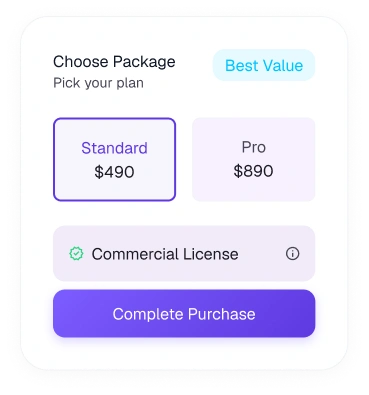
Standard gives you the web platform and admin panel. Pro adds native Android and iOS apps, and our team manages the app store submission. One payment, nothing recurring, nothing added to your monthly overhead.
Step 2
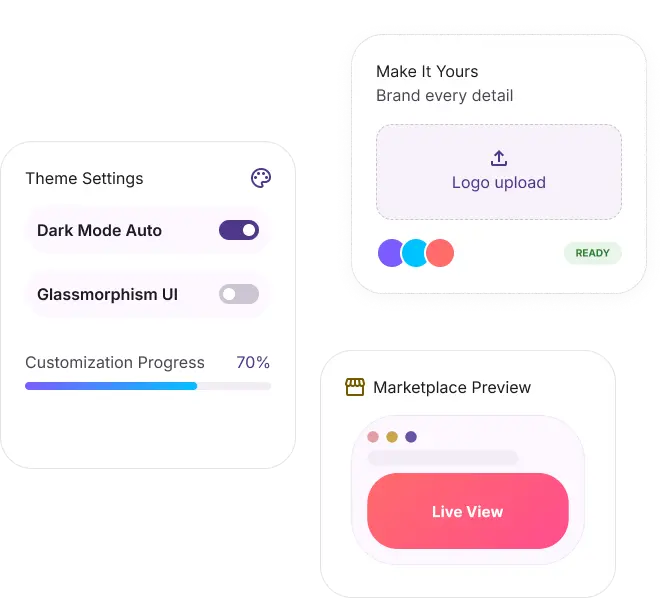
Send Us Your Brand Assets
Send your business name, logo file, hex color codes, and the city you’re launching in. That’s the full handoff. From that point, our team configures the entire platform identity on your behalf.
Step 3
We Deploy on Your Server
Grant server access and our engineers install the backend, initialize the database, wire up payment gateways, and run a full functional check before handing over. The deployment is part of the purchase price.
Step 4
Market Configuration
We configure fares, surge zones, vehicle categories, commission tiers, languages, and local currency to reflect how your specific market operates. Nothing defaults to a global average that doesn’t fit your city.
Step 5
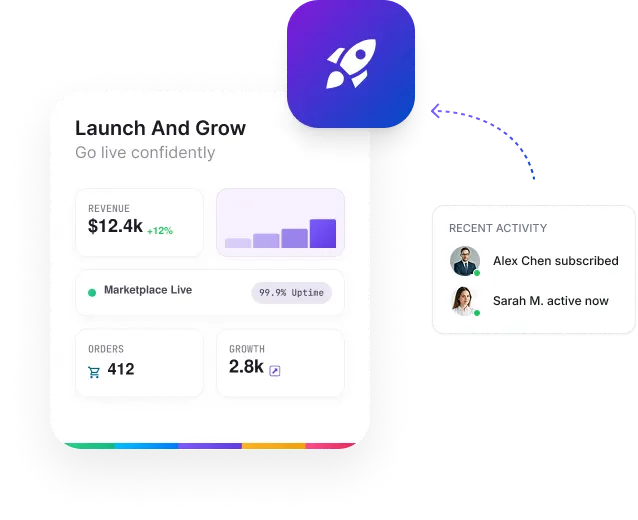
Launch & Handover
Platform goes live. Apps enter the store review queues. Source code lands in your repository. From delivery forward, the platform belongs to you entirely, with no ongoing dependency on Zipprr.
Why the Bolt Model Works
01
Lower take-rate wins driver loyalty
At 15–20% per ride, Bolt keeps more money in drivers’ pockets than rivals. That gap explains why fleets grow faster when you run the Bolt model
02
Active in 850+ cities spanning six continents:
The same platform adapts from Tallinn to Lagos to São Paulo, proof that the product scales across every market it enters
03
Multi-service super app
Four services running under a single platform: rides, food delivery, e-scooters, and shared vehicles
04
$8.4B+ valuation
One of Europe’s highest-valued transport technology companies
05
Ride-hailing market projected at $220B+ by 2028
Massive headroom for new regional operators
Platform Features
Bolt Clone App Features: Rider App, Driver App and Admin Panel
Three distinct apps. Three distinct users. Every feature in each one was chosen because it solves a real operational problem, not added to pad a feature list.
Rider App
Bolt Clone Rider App Features for a Seamless On-Demand Booking Experience
📍 Instant Ride Booking
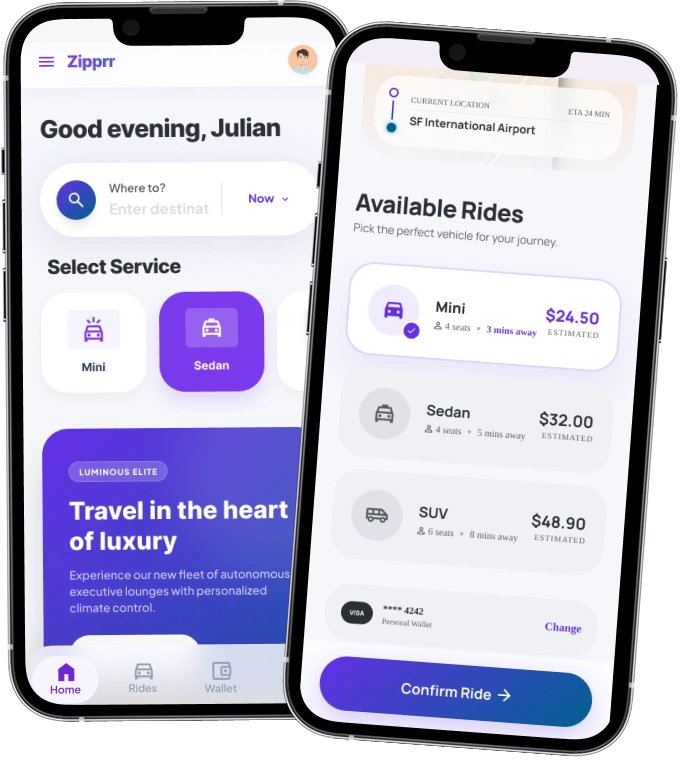
Open the app, pick a destination, see the exact price before confirming. The driver is dispatched the moment you tap. Most bookings wrap up in under 20 seconds, from app open to wheels rolling.
🗺️ Real-Time Driver Tracking
A live pin tracks your driver’s position, refreshed every few seconds. Riders see which street the car is on, how many minutes until arrival, and the exact route being taken.
💳 Multi-Payment Methods
Riders pay by cash, card, or a pre-loaded in-app wallet. Regional gateways including M-Pesa and Flutterwave connect natively, so payment method is never the reason a trip doesn’t complete.
⭐ Ratings & Reviews
Every completed trip triggers a two-way rating. Accounts that fall below the threshold get flagged for admin review without anyone on your team needing to chase individual complaints.
🔁 Ride Scheduling
Riders book up to seven days out and get a confirmation the moment a driver accepts. The 5am airport run is locked in the night before, not frantically requested at 4:45am.
🚨 In-App SOS & Safety
A single tap broadcasts live trip coordinates to pre-saved emergency contacts. Driver photo, vehicle plate, and ride details stay on screen from the moment of matching until the trip ends.
🎁 Promo Codes & Referrals
Launch referral campaigns, create discount windows, and track redemption rates, all controlled from the admin panel. Your first 500 riders can be acquired at a fraction of standard customer acquisition cost.
🌐 Multi-Language Support
Flip the interface into any of 30+ supported languages directly from the admin panel. RTL scripts like Arabic and Urdu render correctly with zero additional development required.
Driver App
Bolt Clone Driver App Features: Earnings, Navigation and Fleet Management
📲 Smart Ride Requests
Each incoming request shows the pickup area, passenger star rating, drop-off district, and estimated payout before the driver commits. Accept rates climb because nothing is hidden before the tap.
🧭 Optimized Navigation
Traffic-aware turn-by-turn routing is embedded directly in the driver app. Drivers complete their full shift without switching to Google Maps once, and without missing a single notification.
💰 Earnings Dashboard
Trips completed, commission deducted, and net payout: all visible in daily, weekly, or monthly view. Drivers know their exact balance without waiting for a settlement email.
📋 Digital Document Upload
License, registration, insurance: photographed from the driver’s phone and submitted in the app. Admin approves from the dashboard. A new driver can go from sign-up to first trip without ever visiting your office.
🏆 Incentive & Bonus Tracking
Streak bonuses, peak-hour multipliers, and launch-week promotions all show on the driver’s home screen in real time. The target is visible, progress updates after each trip, and the bonus releases automatically on completion.
💸 Instant Payout Options
Pay drivers daily to a digital wallet, weekly by bank transfer, or through a cash settlement workflow you control. Faster pay cycles are one of the most direct ways to keep drivers choosing your platform over a rival.
Admin Dashboard
Bolt Clone Admin Dashboard: Real-Time Controls, Analytics and Surge Pricing
🖥️ Unified Control Panel
Live trips, driver statuses, rider accounts, zone settings, and payout queues: all in one browser tab. Open it from any device with an internet connection. No software to install, no dedicated machine required.
📊 Real-Time Analytics
Active trips move across a live map in real time. Revenue graphs update by the hour. Zone-level demand heatmaps show where to concentrate driver supply before the next peak builds.
⚡ Surge Pricing Controls
Set surge rules by zone, vehicle class, and demand threshold. When the stadium empties or rain hits simultaneously across three districts, multipliers activate on their own. You set the ceiling; the system handles the trigger.
💼 Fleet Management
Every vehicle plots on a live map, filterable by type and sortable by idle time. Reassign a driver to a different zone mid-shift, pause an account pending document review, or flag a top performer for a bonus, all from the same screen.
🔧 Commission Management
Write commission rules that match your market: a flat rate for new drivers, a lower cut after 500 completed trips, a separate tier for premium vehicles. Each rule takes effect immediately, no code push required.
🌍 Multi-City, Multi-Country
Operate Lagos and Nairobi as separate businesses from one login. Each city carries its own fares, zones, currency, and payment processor. Revenue and driver data stay completely isolated between markets.
AI-Powered Platform
AI-Powered Bolt Clone Script: Smart Ride-Hailing Technology Built for 2026
The platforms that win the next decade of mobility won’t just dispatch cars faster. They’ll use machine intelligence to do it smarter. Every AI feature below ships with the platform, no extra module pricing.
AI-Powered Dispatch
“Nearest driver” is a blunt instrument. The dispatch engine weighs ETA against the driver’s current route trajectory, their acceptance history, vehicle class, and passenger rating — selecting the optimal match rather than just the closest dot on the map.
ML-Based Surge Pricing
A stadium event, a sudden rainstorm, a delayed flight. These demand spikes don’t wait for a human to react. The ML pricing layer reads live request volume against historical baselines and adjusts multipliers automatically before queues build up.
Intelligent Route Optimization
Static map directions ignore what happened on that road ten minutes ago. The routing layer pulls live traffic feeds, cross-references learned speed patterns by hour and day, and generates paths that consistently shave minutes off average trip times.
Demand Forecasting
Instead of reacting to demand spikes after they happen, the forecasting model pushes driver availability alerts 20–30 minutes ahead of predicted surges, so supply and demand meet at the right moment instead of chasing each other.
Fraud & Anomaly Detection
GPS coordinates that teleport between pings, accounts that complete suspiciously identical trips, drivers who log off the moment a payment is triggered. The anomaly engine catches patterns humans miss and flags them before payout.
Predictive ETA Engine
Raw distance divided by average speed gives a number, not an estimate. The ETA engine factors in the driver’s routing behavior, that specific pickup address’s historical access complexity, and current block-level congestion to produce an arrival window riders can actually trust.
Bolt Clone Script vs. Custom Ride-Hailing App Development: Full Comparison
Custom development has a time and a place. For a ride-hailing platform that already has a proven feature set, it’s rarely the smart opening move. Here’s the real comparison.
Factor
Zipprr Bolt Clone
Custom Development
Upfront Cost
✓
$490 – $890 (one-time)
✕
$50,000 – $200,000+
Time to Launch
✓
7 days average
✕
6–18 months
Source Code Ownership
✓
100% ownership on day one
✓
Yes (if contracted correctly)
White-Label Branding
✓
Fully custom name, logo, colors
✓
Custom by definition
Feature Completeness (Day 1)
✓
All core features included
✕
Only what's in the spec
Post-Launch Support
✓
3 months included, 24-hr turnaround
✕
Separate retainer required
Future Releases
✓
Every new version ships to you free
✕
Each update cycle is a new invoice
Market Validation Risk
✓
Low: test with real users in days
✕
High: 12+ months before your first user
AI Features (2026-Ready)
✓
Built-in AI dispatch & pricing
✕
Extra cost to implement
App Store Submission
✓
Included in Pro plan
✕
Additional cost & effort
Why Launch a Taxify Clone App? The $220B Ride-Hailing Market Opportunity
The global platforms already proved that people will pay for on-demand rides. What they didn’t do is go everywhere. The white space they left behind is where independent operators build genuine, profitable businesses.
$
0
B+
Global ride-hailing market projected by 2028
0
+
Cities where Bolt currently operates, proving the model scales
0
+
Countries where on-demand taxi apps are mainstream
0
+
Cities globally where no dominant ride-hailing app exists yet
How to Make Money With Your Bolt Clone App: 6 Built-In Revenue Streams
Most ride-hailing operators know about commissions. Fewer have mapped out the four other income lines sitting inside the same platform. Here’s the full picture.
💰
Driver Commissions
Every completed trip, you take 15–25% before the driver gets paid. That’s automatic, happens in the background, and compounds daily. At 200 trips and a $15 average fare, you’re collecting $450–$750 every single day without lifting a finger.
⚡
Dynamic Surge Pricing
A 2× surge at Friday rush hour doesn’t just benefit drivers. It doubles the fare your commission is calculated on. Surge events that happen 3–4 times a week can add 20–35% to your monthly gross without a single extra trip.
🥗
Food & Grocery Delivery
Flip on the delivery module and you’re now a marketplace for restaurants. Charge 20–30% per order. Fifty active restaurant partners at 20 orders a day each generates serious revenue from the same driver network you already have.
🏢
Corporate Mobility (B2B)
Companies pay monthly for guaranteed employee transport: airport runs, client pickups, site visits. Corporate accounts pay on invoice, churn rarely, and give you predictable revenue that doesn’t fluctuate with weekend weather.
🎯
In-App Advertising
A rider waiting for their driver is staring at their phone. That 90-second window is valuable to local restaurants, hotels, gyms, and retailers, all of whom will pay monthly for that visibility. Low effort, high margin, zero conflict with your core product.
🛴
Micromobility Rentals
E-scooters and bikes unlock short-distance trips your sedan fleet won’t take profitably. Bill by the minute, park the vehicles in high-footfall zones, and let the same app your riders already have on their phones handle the booking.
Ready to Launch Your Own Bolt Clone Ride-Hailing Business?
More than 100 operators across 50+ countries invested $490 to $890 in a proven platform rather than $100,000+ on a two-year custom build. Their platforms are live, their drivers are earning, and commission revenue runs every day. See the platform working in a live demo before you decide. No sales pressure, just the product.
Best Markets to Launch Your Bolt Clone Ride-Hailing App Right Now
Sub-Saharan Africa
Mobile money wallets, not bank cards, power payments in Kenya, Nigeria, and Ghana. A platform wired to M-Pesa and Flutterwave from day one immediately outperforms any international app that built payment as an afterthought. Bolt’s African city coverage ends at the major metros. The tier-2 gap is enormous.
Southeast Asia
Grab dominates the capitals. Outside of Jakarta, Manila, and Ho Chi Minh City, most secondary cities still run on phone calls and loose scheduling. That’s where a locally operated, locally priced app takes root. The populations are large enough to sustain a real business.
Latin America
Uber holds market share in Latin America’s major cities yet still loses ground to local operators in hundreds of smaller metros. Brazil, Colombia, and Mexico have smartphone penetration high enough to support a serious ride-hailing platform. Local language, local payment (PIX in Brazil, SPEI in Mexico), local trust. These are advantages a foreign platform can’t replicate overnight.
South Asia Tier-2 Cities
Beyond the Olas and Rapidos of India’s top 20 cities are several hundred towns where the auto-rickshaw driver still gets bookings via a shared WhatsApp group. An affordable, locally branded app with an auto and bike taxi mode built in is not competing with a tech giant. It’s replacing a fragmented, cash-heavy process that riders are already tired of.
Get What You Pay For Pricing
Not happy with our product? No worries! Get a 100% refund within 7 days. Choose your plan with confidence—risk-free!
Standard
Get essential features, all in one place
$490
- Website Source Code
- Admin Source Code
- Website Installation
- 90 Days Support
- Life Time Updates
- One Time Payment
- Android App
- IOS
- App Submission
Pro
Popular
Launch your business app fast, with everything done-for-you
$890
- Website Source Code
- Admin Source Code
- Website Installation
- 90 Days Support
- Life Time Updates
- One Time Payment
- Android App
- IOS
- App Submission
- Get Started
Launch Your Marketplace Business With Zipprr
Book a personalized demo and discover how Zipprr helps you launch a fully customizable marketplace solution built for growth.
Can we customize the platform?
Yes, every solution can be tailored to your business.
-
100% Source Code Ownership
Complete control from day one
-
Custom Branding
Your logo, colors and identity
-
Multi Vendor Ready
Manage sellers, roles and payouts
-
Built To Scale
Grow without limits
- 30 Minute Product Walkthrough
Request Your Free Demo
Book a personalized demo and discover how Zipprr helps you launch a fully customizable marketplace solution built for growth.
- 100% source code ownership
- Custom feature discussion
- Free product consultation
- 90 days launch support
Everything You Need to Know Before You Buy
Get answers to frequently asked queries about our solution

What is a Bolt clone app?
A Bolt clone is a ready-made ride-hailing app script replicating Bolt’s taxi booking model, with driver-friendly commissions, real-time dispatch, and three apps: rider app, driver app, and admin panel. You receive 100% source code, rebrand it as your own, and launch on your own server with no revenue sharing.
How much does a Bolt clone cost?
A Bolt clone from Zipprr costs a one-time $490 for Standard and $890 for Pro, versus $50,000–$200,000 for custom development. Both include full source code, installation, and 90 days of support. Pro adds native Android and iOS apps plus app-store submission, with no subscriptions or hidden fees.
How long does it take to launch a Bolt clone?
Launching a Bolt clone takes about 7 business days. Days 1–2 cover branding and server access, days 3–5 handle installation and payment setup, and days 6–7 cover testing and handover. App-store approval adds 1–3 days for Android and 2–5 days for iOS on top.
What is the difference between a Bolt clone and an Uber clone?
Both a Bolt clone and an Uber clone offer ride booking, live tracking, and surge pricing. The difference is built-in strategy: this ride-hailing app script defaults to leaner driver commissions (15–20% versus Uber’s 25–30%), faster payouts, and settings tuned for tier-2 cities where driver acquisition matters most.
Do I get the full source code with a Bolt clone?
Yes, every Bolt clone plan delivers full, uncompiled source code. Standard includes the web platform and admin panel; Pro adds native Android and iOS codebases. Files arrive on delivery day, so any developer can read, modify, extend, or migrate the taxi booking software without Zipprr’s involvement.
Is a Bolt clone legal to sell and rebrand?
Yes, a Bolt clone is legal. “Bolt clone” is a product category, not a trademark claim. The ride-hailing app script is written from scratch and copies no proprietary code or assets. Your finished product carries your name, logo, and branding, with no affiliation with Bolt or Taxify.
What does white-label mean for a Bolt clone?
A white-label Bolt clone ships with zero vendor branding, no Zipprr watermark, and no “powered by” attribution. You supply the name, logo, colors, and app-store listing, and that is all riders and drivers see. Your taxi booking software looks like a standalone product built by your company.
Can I customize the features and design of a Bolt clone?
Yes. A Bolt clone is customizable on two levels: no-code configuration of fares, commissions, zones, languages, currencies, and branding through the admin panel; and full code-level changes like corporate booking or new payment gateways, because you own the ride-hailing app script source code outright.
What payment gateways does a Bolt clone support?
A Bolt clone supports Stripe, PayPal, and Braintree out of the box. Flutterwave and Paystack are available for Africa, and Razorpay and Paytm for South Asia. It also ships with an in-app wallet and full cash-ride support, so the payment method never blocks a completed trip.
Does a Bolt clone support multiple languages and currencies?
Yes. A Bolt clone ships with 30+ language packs, including right-to-left rendering for Arabic, Urdu, and Hebrew. Currency is set per city, so you can run Kenya and Nigeria together, each billing in its own currency. Adding one needs no redeployment or app-store update.
Can I add food delivery or scooter rental to a Bolt clone?
Yes. A Bolt clone runs on a service-agnostic dispatch engine, so the same ride-matching infrastructure can power food delivery, grocery, or e-scooter rentals with the right module added. Most operators launch rides first, then add delivery later. Modules are quoted per implementation, not sold as subscriptions.
How do I make money with a Bolt clone?
A Bolt clone earns mainly through commissions, and your platform keeps 15–25% of every fare automatically. At 300 daily trips and a $12 average fare, a 20% cut yields roughly $720 daily (~$263,000 yearly per city). Surge pricing, corporate accounts, in-app ads, and delivery add more.
Will a Bolt clone scale as my user base grows?
Yes. A Bolt clone scales horizontally. Trip logic, the real-time socket layer, and database caching run as separate services, so you scale only what’s overloaded. Redis handles live ride-matching at high concurrency. Operators typically move from a single droplet to load-balanced AWS with no code rewrite.
What support and refund policy comes with a Bolt clone?
Every Bolt clone includes 3 months of technical support with a 24-hour response guarantee, plus all future platform uupdates are ree for life. You also get a 7-day, no-questions-asked refund from the purchase date, so you can test the taxi booking software risk-free before committing fully.
Do I need technical skills to run a Bolt clone?
No coding skills are needed to run a Bolt clone daily. The admin dashboard is a standard web app. Log in from any browser to approve drivers, track live trips, set fares, run promotions, and process payouts. Server upkeep and new features suit any web developer.